First: the cells swell
Put the stratum corneum in water and it takes water up. Corneocytes are absorbent by design, and prolonged immersion causes them to swell substantially. Anyone who has looked at their fingertips after an hour in the sea knows what this looks like.
The wrinkling is the visible sign; the structural consequence is that swollen cells push apart, and the ordered lipid sheets between them are stretched and disordered. That disorder is a barrier failure even though nothing has been removed. Water leaving the body now takes a shorter, straighter path.
Swelling reverses. The cells give up the excess water as the skin dries, and within an hour or two the mechanical part of this is done. It is the least of the three effects.
Second: the internal water holders are rinsed out
Inside each corneocyte is a mixture of small water attracting molecules produced as a large protein is broken down during the cell's final maturation. Amino acids and their derivatives, urea, lactate, salts. Their function is to hold water inside the outer layer so that it stays flexible.
They are water soluble. That is what makes them work and it is also what makes them vulnerable. Prolonged immersion, and particularly repeated prolonged immersion, carries them out of the cells and away.
The result is a stratum corneum whose cells have a reduced capacity to hold water. This is the effect that produces the complaint that most confuses people: skin that feels fine for an hour after applying something and then feels tight again. You have restored a film on top. You have not restored the cells' ability to hold water, and nothing applied does.
Recovery here is by the arrival of new cells from below, which is days to weeks. This is why a single big session is survivable and a winter of four a week is a different proposition.
Third: the salt film left behind
This is the effect that is most under your control and least often addressed.
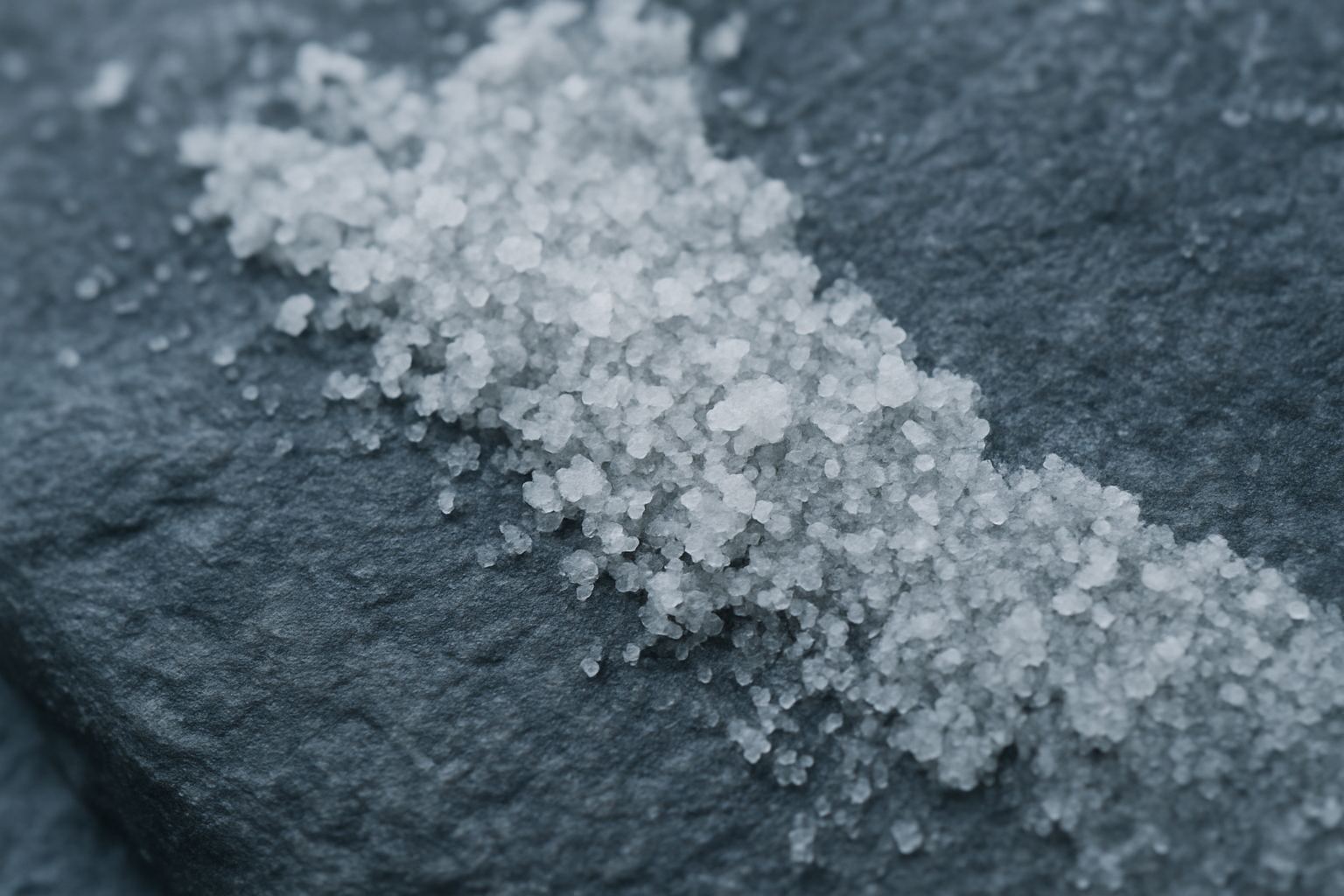
When you come out of the sea, the water on your skin evaporates and the dissolved salts do not. What is left is a film of salt crystals and concentrated brine sitting on the surface.
Salt is water attracting. A concentrated salt film on the skin surface sits in equilibrium with the water in the layer beneath it, and while it is drying it will draw water from that layer. In effect you have applied a drawing agent to skin that has just had a hard hour.
It also has a mechanical role. Salt crystals on the skin, under a towel, under a collar, inside a glove, are abrasive particles. Drying a face briskly with a towel while it is covered in salt crystals is an abrasion event.
Rinsing with fresh water removes the film. That is the whole intervention, and it takes under two minutes, and it does more for post session skin than anything you could apply afterwards.
| Effect | How long it lasts | What addresses it |
|---|---|---|
| Corneocytes swollen, lipid sheets disordered | An hour or two after drying | Nothing needed, it reverses |
| Internal water attracting molecules rinsed out | Days to weeks, needs new cells | Fewer or shorter immersions, and an emollient while damp |
| Salt film drawing water at the surface | Until you rinse it off | Fresh water, promptly, everywhere including the scalp |
| Salt crystals as abrasive particles | Until rinsed, then the damage is done | Rinse before drying, blot rather than rub |
Ordering framework written by this publication from general skin physiology. It is not a measurement, it is not taken from any study, and no number in it is a reading.
And the parts you forget
Salt does not only sit on the exposed face. It sits in the scalp under hair, where it is hard to rinse and stays for hours. It sits in the ears and behind them. It sits at the hairline, under a beard, in the folds behind the knees, and in every seam line of a wetsuit.
Those are the places that turn out to be worst in February, and they are worst because they were never rinsed. There is more on scalp and hair in the article on scalp and hair.
Salt water and broken skin
A great deal of folklore says sea water is good for skin problems. We are not going to endorse or dismiss that, because it covers several different claims and most of them are outside what a physiology publication should assert.
What we will say is narrow and defensible: broken skin immersed in natural water is broken skin exposed to whatever is in that water. Cuts, cracks, grazes and open fissures should be treated as entry points, and if a wound after sea water exposure becomes red, hot, swollen, increasingly painful or starts discharging, that is a same day matter for a pharmacist or a GP rather than a subject for reasoning. Water quality in British coastal waters varies and is a public matter, not a personal one.
The order that works
The post session sequence that follows from the mechanisms is short.
Rinse with fresh water as soon as practical, including the scalp, the hairline and anywhere a seam sat. Cool or lukewarm, not hot.
Do not use detergent on skin that only has salt on it. Salt rinses off with water. Reserve the wash for the parts that genuinely need washing.
Blot dry rather than rubbing, particularly the face.
Apply while still slightly damp, because an occlusive layer applied over damp skin holds more water in the layer than the same layer applied to dry skin.
And accept that the internal water holding capacity of your outer layer will be below par for a few days after a heavy week, and plan around that instead of trying to fix it.