A materials problem, described as one
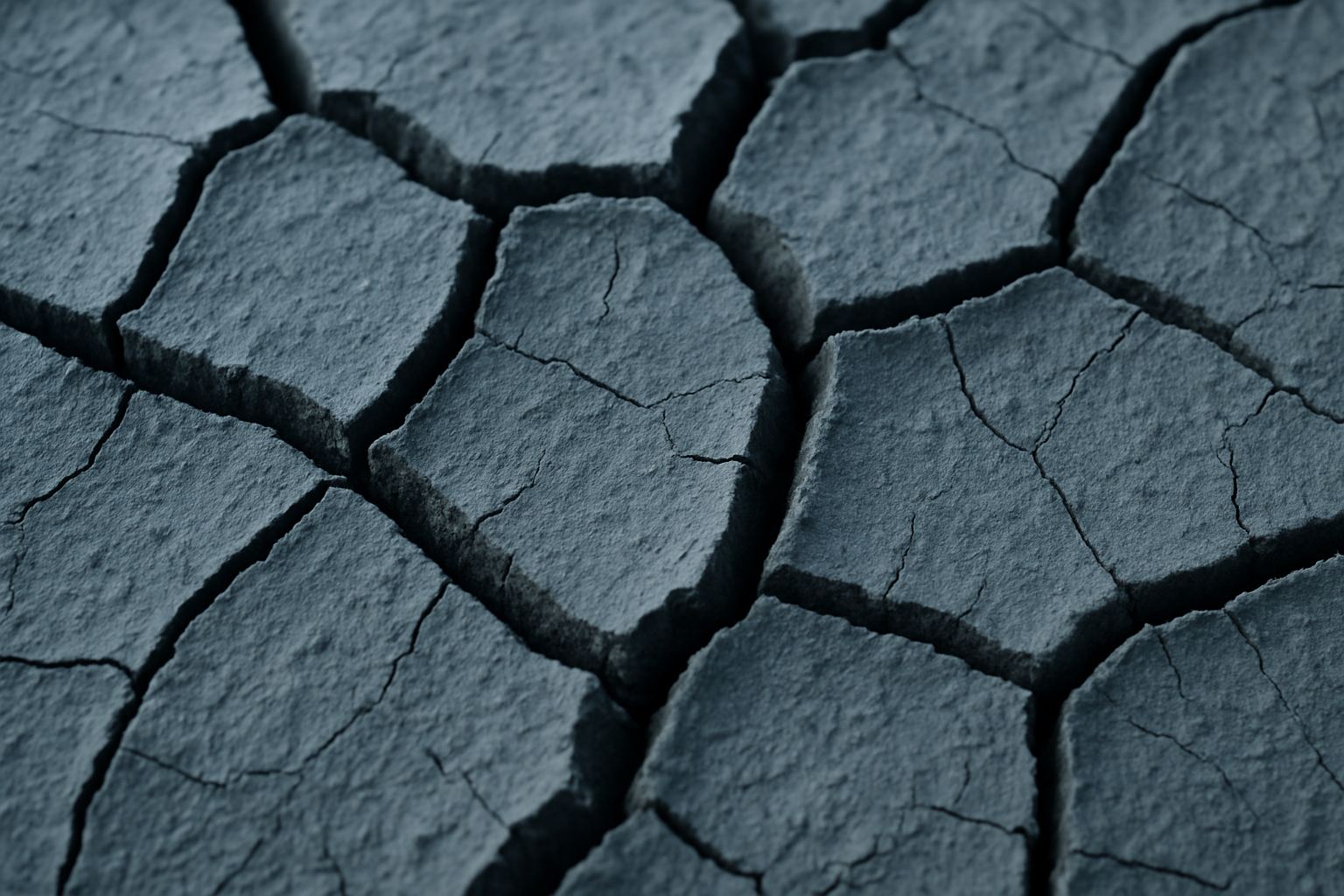
Take a sheet of any stiff material with limited flexibility and bend it repeatedly. It does not wear away gradually. It develops a crack at the point of highest tensile stress, and the crack propagates.
The stratum corneum on a hand is exactly this. When its water content is adequate the sheet is flexible and it accommodates bending. When its water content falls it stiffens, and stiff sheets crack.
Where the crack forms is determined by the stress field. On a hand, that is across a knuckle crease, at the sides of the finger pads, at the base of the thumb, and around the nail folds. Those are the places where the skin is loaded in tension every time the hand is used.
Why it hurts so much
The stratum corneum is dead tissue and contains no nerves. A superficial split in it would not hurt.
The pain of a fissure comes from the crack extending down past the dead layer into the living epidermis, where nerve endings from below reach up. It also comes from the crack being opened and closed mechanically, which repeatedly stimulates those endings.
The result is a small injury that produces pain out of all proportion to its size, which is why people are surprised by how much a two millimetre split on a fingertip interferes with a day.
How a fissure closes
A fissure heals by epidermal cells migrating across the gap from both sides and re establishing a continuous sheet, after which the outer layer above it is rebuilt.
Two things determine how long that takes. The depth and width of the gap. And how often it is pulled open before the bridging is complete.
The second is the dominant variable for a working hand, and it is the reason winter fissures last weeks rather than days. A split that is pulled open two hundred times a day is being asked to bridge in the gaps between interruptions.
This is why anything that mechanically holds the edges together is doing the single most useful thing available, and why a night is worth more than a day: eight uninterrupted hours is where most of the bridging actually happens.
| Site | The load that causes it | The control that fits |
|---|---|---|
| Across a knuckle crease | Tension every time the hand closes | Flexibility overnight, and reducing washes |
| Sides of the finger pads | Grip and pinch loading | Warmth, and protection during use |
| Around the nail folds | Constant small movements and frequent wetting | Fewer wet and dry cycles, and drying properly |
| Base of the thumb | High load, thick layer, wide range of movement | Flexibility, and mechanically holding a split closed |
| Heel of the palm | Pressure and shear under tools and grips | Load spreading, and gloves that fit |
Ordering framework written by this publication from general skin physiology. It is not a measurement, it is not taken from any study, and no number in it is a reading.
Preventing them is easier than closing them
The controls that prevent fissures follow directly from the materials picture.
Keep the layer flexible. That means keeping its water content up, which means applying something that slows evaporation, generously, at night, when nothing will remove it. This is the whole reason the advice exists.
Keep the hands warm. Cold tissue is stiffer tissue. A cold hand gripping a cold rail is a stiff sheet under bending load. Gloves between sessions are a barrier intervention, not just a comfort one.
Reduce the number of washes. Each one removes lipid and raises pH, and both make the layer drier and stiffer.
Attend to the earliest sign. Roughness at a knuckle in November is the free warning. By the time there is a split, you have lost the cheap option.
Once you have one
The mechanical problem is keeping the edges together while bridging proceeds, and reducing the number of opening events.
How you achieve that is a practical question with several ordinary answers, and it depends on where the split is and what you have to do with your hands. What we will not do is tell you what to put on it or in it, because that is treatment and we do not do treatment.
What we will say is that a pharmacist is well placed to advise on a cracked hand, that this is exactly the kind of thing community pharmacy exists for, and that you do not need a GP appointment to get useful advice about a fissure.
If it is your work
Hand skin problems in people whose work involves frequent wetting, washing, gloves or contact with materials are treated in Britain as an occupational health matter. The Health and Safety Executive publishes guidance for employers and workers on preventing work related skin problems, and employers have duties in this area.
If your hands are cracking and your job requires repeated hand washing, glove use or contact with cleaning products, solvents, cement, fish, food or oils, say so when you seek advice. It changes what should happen next, and there may be controls available at work that you are not aware of. There is more in the article on occupational skin.